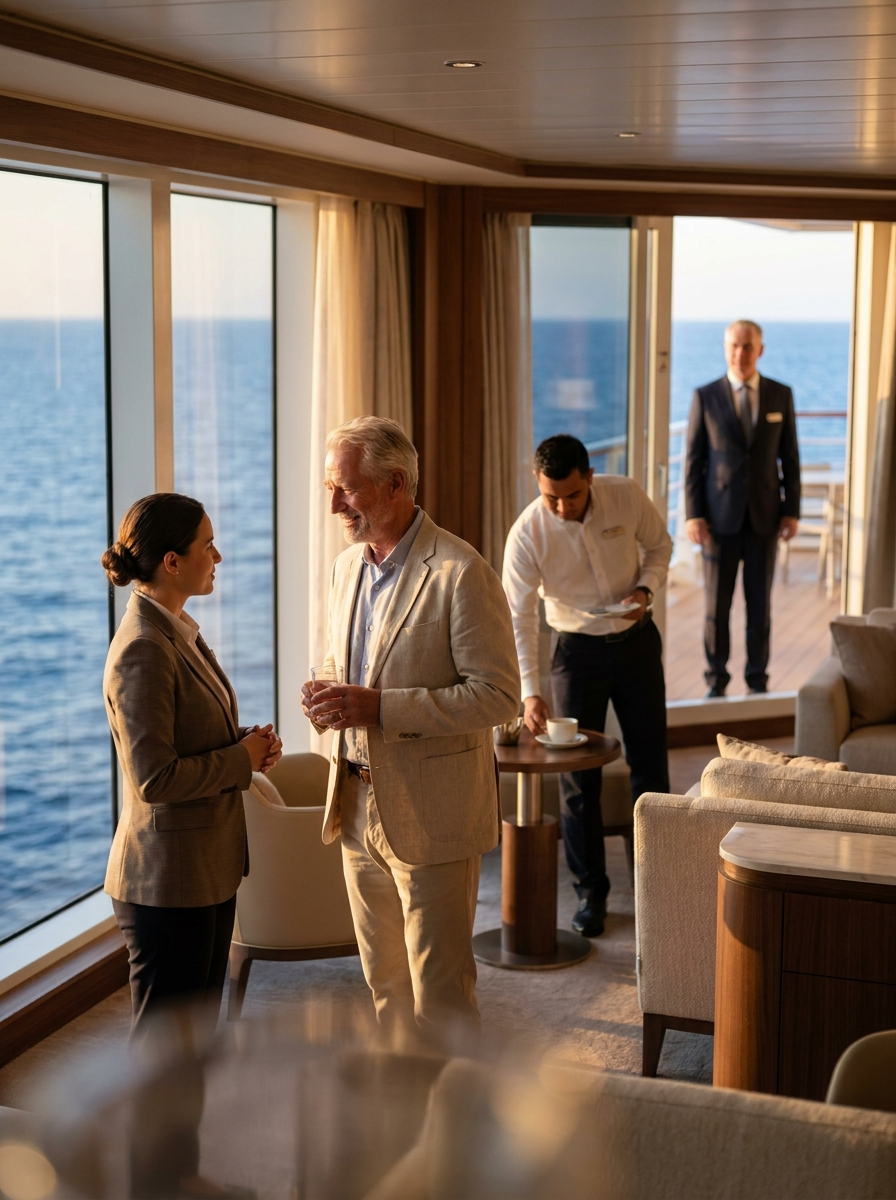
Cruise Line Guest Experience Training
One guest. Five teams. One continuous story.
Your guest does not experience reservations, embarkation, their suite, dining and shore excursions as separate departments. They experience one voyage.
Every time the story restarts, a little trust goes with it.
We help your teams carry the guest forward instead of handing them on.
What is cruise line guest experience training?
Cruise line guest experience training helps shipboard and shoreside teams recognise, interpret and respond to the behaviours that shape how a voyage is felt. It strengthens continuity, handovers, recovery and judgement across departments, roles and cultures, so the guest experiences one relationship rather than a sequence of separate ones.
It sits alongside safety, regulatory, technical and brand training. It does not replace any of them.
The continuity model
- 01
Booking
Why they are travelling is revealed for the first time.
- 02
Embarkation
Pace, uncertainty and the first signs of trust appear.
- 03
The suite
Recognition either feels personal or feels procedural.
- 04
Dining and leisure
Context travels with the guest, or it resets.
- 05
Shore and return
Whatever happened ashore comes back onboard with them.
Internally these are five teams. To the guest they are one story. The work is making sure the meaning travels, not just the information.
Nobody drops the guest. They just keep handing them on.
Your standards, training records, guest surveys and complaint reports tell you what was taught, completed, rated and resolved. All of it necessary. None of it shows what happens in between.
What the systems do not see
A guest explains why they are travelling when they book. By day three they have explained it four more times, to four different people, each of whom handled it perfectly.
A shore excursion is cancelled. The alternative is arranged correctly and quickly. Nobody onboard knows the guest is flat for the rest of the week.
A charge is corrected at guest services. The guest is gracious about it and never returns to that bar.
A newer crew member knows the process. The guest is asking for something the process does not cover, and they are not sure how far their authority goes.
Someone says everything is fine and stops asking for anything at all.
None of this generates a complaint. That is exactly the problem. The absence of a complaint is not evidence that a guest feels looked after.
The reason cruise is harder than hotels
Count the interactions. A two night hotel stay might involve a handful of people. A seven night voyage involves reservations, embarkation, a suite host, housekeeping, several dining venues, bars, guest services, the excursions team, the spa and disembarkation.
- Reception
- Housekeeping
- A restaurant
- Reservations
- Embarkation
- Suite host
- Housekeeping
- Dining venues
- Bars
- Guest services
- Excursions team
- Spa
- Disembarkation
A hotel has to get a few handovers right. You have to get dozens right, for a week, at sea.
We start with one question, not a programme.
- 01
Agree what you need to understand
Recovery that varies by venue. Guest context lost between departments. Weak handovers. Training that does not survive contact with a real voyage. You choose the question.
- 02
Watch the journey
A Human Impact Audit observes agreed shoreside and shipboard touchpoints, crew interactions, handovers and leadership moments. Observation is overt and agreed with you in advance.
- 03
Separate the incident from the pattern
One difficult interaction is an incident. The same thing happening across three venues is a pattern, and patterns usually have a cause in authority, workload or handover design rather than in the individual.
- 04
Practise the response
Practice Labs are our rehearsal sessions for the decisions the standard does not cover. Delivered centrally, before embarkation, onboard or blended, depending on the roles and access.
- 05
Strengthen what works
Leaders revisit a small number of observable behaviours through follow up and coaching, then decide whether the learning stays with one vessel or is worth taking further.
The aim is not identical crew or rehearsed warmth. It is a shared quality of attention that people can apply inside their own role and authority.
Six things that decide whether a voyage feels connected.
| Capability | What it strengthens |
|---|---|
| Continuity across handovers | Passing on the reason behind a request, not only its status. |
| Recognition that lands | Making recognition feel relevant rather than performed or pulled from a database. |
| Cultural and generational context | How tone, directness, silence, hierarchy and personal space are read differently by international guests and crew. |
| Judgement under pressure | Better decisions when disruption, time or authority leave the standard response incomplete. |
| Recovery and dignity | Knowing whether the guest actually feels restored after the correction, and following up without sounding defensive. |
| Leadership presence | Coaching that builds confidence in newly joined and experienced crew without creating blame. |
Which of these matter most depends on the line, the vessel, the route and the guest profile. A reservations agent, a suite host, a dining leader and a hotel director may share one behavioural theme and still need completely different practice, because they hold completely different authority.
This is a hospitality problem, not a maritime one.
Cruise lines already have excellent systems for the things that are specific to ships. Safety, compliance, technical competence and brand standards are not where voyages come apart.
Where they come apart is the same place it happens in every luxury property. A handover that carries the task but not the reason. A correct process that produces the wrong feeling. A complaint closed before the relationship is repaired.
That problem does not change at sea. It just happens far more often, because there are far more handovers.
| Existing approach | What it covers | What we add |
|---|---|---|
| Safety, regulatory and technical training | Safe, compliant, competent operation. | The guest facing judgement that sits inside those boundaries. |
| Brand and service standards | What should happen, and how. | What to do when a correct process does not produce the intended feeling. |
| Guest surveys and complaint reports | What guests rate, report or escalate. | What changes before, between and after the things that get reported. |
| Mystery guest and quality review | Performance against criteria at chosen moments. | Continuity, timing, handovers and recovery across the whole journey, followed by practice. |
Key messageWe do not replace the systems that keep a ship safe and consistent. We strengthen the people who have to make the experience feel connected when reality stops following the plan.

Freddie Lovett has spent his career inside luxury hospitality, alongside the leaders and teams responsible for delivering the guest experience in real time.
He knows the handover that loses the reason behind a request, the employee who hesitates because authority is unclear, the complaint that is resolved while trust is not, and the leader trying to change behaviour without creating fear.
For cruise work, the method is built with your operations and learning leaders around the realities of the vessel, route, crew and existing training environment.
Meet Freddie LovettQuestions from cruise operations and learning leaders
What does cruise line guest experience training include?
Typically a Human Impact Audit of agreed shoreside and shipboard touchpoints, a set of behavioural priorities drawn from what it finds, role specific Practice Labs, leadership support and follow up against observable behaviours. Scope follows your question rather than a fixed course.
Is this basic training for new crew?
No. It can support newer crew, but it is designed as an organisational capability. Newly joined, seasonal, rotating and experienced crew often need different practice even when they are serving the same guest.
How do you observe crew onboard, and is it covert?
Observation is overt and agreed with you in advance. We work within your access, safeguarding, confidentiality and crew representation requirements, and we agree the boundaries before anyone joins a vessel. Nothing is recorded or reported at individual level without your agreement.
Can it be delivered before embarkation or onboard?
Both. Practice can run centrally, before embarkation, onboard or as a blend. The right format depends on roles, vessel access, schedule, languages and scope.
How is it adapted for multicultural crews and guests?
Scenarios are examined in context. We look at how tone, directness, silence, hierarchy and personal space may be read differently, then build a shared language without treating one culture or personality as the standard.
How is this different from a mystery guest programme?
A mystery guest assesses defined standards at chosen moments. We look at how trust and context move across a connected journey, then turn what we find into practice and leadership priorities.
Do we have to start across the fleet?
No, and we would advise against it. One guest journey, one vessel, one route or one recurring problem is a better starting point, because it shows you what is local and what repeats.
How is improvement measured?
Against a small number of observable priorities agreed at the start. Quality of handovers, recognition of withdrawal, recovery follow up, decisions taken within authority. These sit alongside your existing guest and operational data.
What does it cost?
It depends on touchpoints, vessels, roles, locations, delivery format and follow up. We define the question and scope first, then give you a specific recommendation.
Make every touchpoint feel like the same promise.
Pick one guest journey, one vessel or one problem that keeps recurring. We will show you where trust and context are being lost, what your teams need to practise, and a sensible place to start.